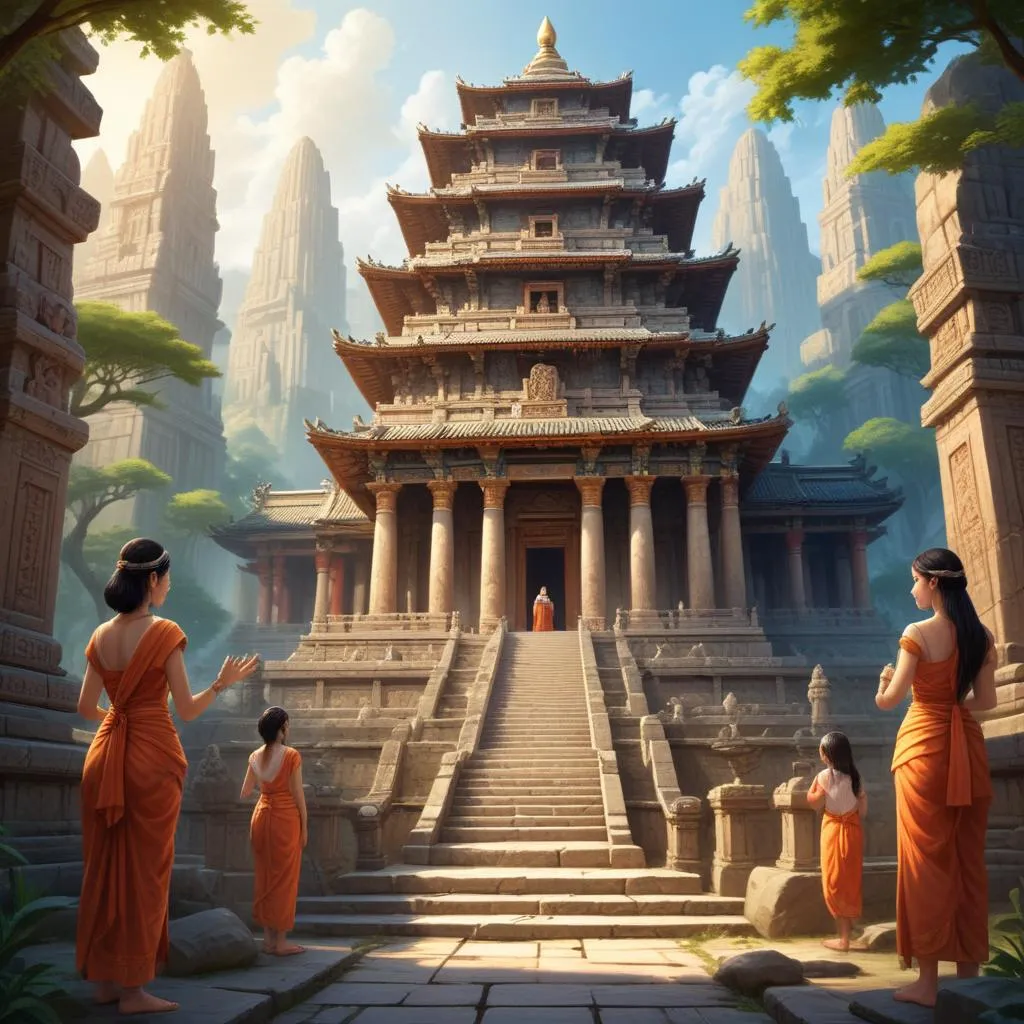
Symbolic representation of ancient wisdom and spiritual principles in architecture.
The Core Conflict: Dharma vs. Adharma in Governance
The political struggle in the Mahabharata isn't merely about a throne, but about competing visions for society. Krishna advocates for Rajadharma—the dharma of rulers—which places collective welfare, justice, and cosmic order above personal ambition. Duryodhana represents Adharma—governance driven by personal desire, attachment, and the belief that power is an end in itself.
This dichotomy remains strikingly relevant today, as leaders and nations grapple with balancing power, ethics, and responsibility.
Krishna’s Worldview: Politics as a Divine Duty
For Krishna, political power is a sacred trust. His counsel to Arjuna in the Bhagavad Gita, delivered on the battlefield, extends beyond personal spirituality to encompass statecraft. Key principles include:
- Duty Over Desire: A ruler must perform their duty (svadharma) selflessly, without attachment to outcomes.
- Welfare of All (Sarva Bhuta Hita): The state exists for the prosperity and protection of all citizens, not just the powerful.
- Strategic Righteousness: Krishna employs strategy and diplomacy (like his peace missions to Hastinapura) but never abandons the ethical framework.
- Detached Engagement: He engages fully in political action while maintaining spiritual equipoise—a model for leaders to avoid corruption by power.
The light of wisdom illuminating principles of duty and righteousness.
Duryodhana’s Worldview: Politics as Personal Entitlement
Duryodhana’s political philosophy is rooted in ego, envy, and a zero-sum view of power. His famous declaration, "I do not see the wealth of the Pandavas being brought forth by dharma, nor do I see my wealth being taken away by adharma," reveals his core belief: might makes right.
Characteristics of Duryodhana’s Approach:
- Possessive Sovereignty: He views the kingdom as personal property to be owned, not a responsibility to be stewarded.
- Selective Dharma: He uses the letter of law (like the dice game) to violate its spirit, showcasing legalism without ethics.
- Power as Validation: His sense of self-worth is tied directly to political dominance, leading to destructive decisions.
- Division as Strategy: He thrives on creating factions (like winning Karna’s loyalty by exploiting his sense of insult) rather than unifying.
Duryodhana’s tragedy is that he is often aware of dharma but consciously rejects it, believing his path—though destructive—is justified by his desires.
The Ultimate Test: Contrasting Approaches to Crisis
The war preparations highlight their differences starkly. When both Krishna and Duryodhana visit Krishna for support before the Kurukshetra war:
- Duryodhana arrives first, sits at Krishna’s head, and demands Krishna’s massive army for himself. He chooses the tangible, brute force.
- Arjuna (representing Krishna’s preferred approach) arrives later, sits humbly at Krishna’s feet, and asks for Krishna himself—as a guide and charioteer, not a warrior. He chooses wisdom and principle over sheer force.
This moment encapsulates the central political lesson: true power lies not in resources alone, but in the ethical and strategic wisdom guiding those resources.

The natural order and flow, mirroring the concept of dharma in governance.
Modern Implications: Which Worldview Prevails Today?
The Krishna-Duryodhana dichotomy manifests in contemporary politics:
Krishna’s Model in Modern Terms:
Leaders who see power as service, prioritize long-term societal health over short-term wins, and uphold ethical boundaries even in political combat. Their authority derives from moral consistency, not just popular appeal.
Duryodhana’s Model in Modern Terms:
Populist authoritarianism, where power is concentrated for personal or partisan glory, institutions are weakened for convenience, and truth is subordinate to narrative control. The end justifies any means.
The Mahabharata ultimately shows that while Duryodhana’s path may offer temporary victories, it leads to systemic collapse. Krishna’s path, though demanding and complex, sustains order and justice.
Conclusion: The Integration of Power and Principle
Krishna does not reject realpolitik—he is a master strategist. But he grounds it in dharma. The lesson isn’t that politics must be saintly, but that without an ethical foundation, power becomes self-destructive. For today’s leaders and citizens, the epic asks: Do we view governance as a platform for service or a tool for possession? The answer determines not just political success, but civilizational resilience.
In an age of complex global challenges, the integration of strategic action with ethical responsibility—the synthesis Krishna embodies—may be the most urgent political wisdom we need to rediscover.