
Ancient texts like the Mahabharata hold profound insights into human nature and cosmic law.
The Mahabharata, one of the world's greatest epics, is far more than a tale of a dynastic war. It is a profound philosophical treatise that grapples with the core human dilemmas of fate, duty, and moral agency. At its heart lies a sophisticated exploration of two seemingly opposing concepts: Karma (the law of cause and effect) and Free Will (the power of conscious choice). The epic does not present a simplistic answer but instead weaves a complex narrative where characters navigate the intricate web woven by their past actions while constantly exercising their will in the present.
The Framework of Karma: The Unavoidable Backdrop
In the Mahabharata, karma is the inescapable cosmic law. Every action, thought, and intention sows a seed that must eventually bear fruit. This is not presented as fatalistic punishment but as a natural, impersonal law of the universe—like gravity. The epic shows how past karmas create the circumstances of the present, setting the stage upon which the drama unfolds.
Key Examples of Karmic Debt
- Draupadi's Humiliation: A past slight by Draupadi to Lord Krishna (though unintentional) is cited as a karmic reason for Krishna's momentary absence during her disrobing, demonstrating that even the protected are subject to cosmic law.
- Bhishma's Vow: His binding oath of celibacy and loyalty to the throne is a self-created karma that ultimately traps him in a terrible ethical conflict, forcing him to fight for the wrong side.
- The Pandavas' Exile: The loss of their kingdom in a rigged game of dice is portrayed as the fruition of complex past karmas, setting them on a path of purification and growth.
The Arena of Free Will: Choices in the Face of Destiny
Despite the powerful undercurrent of karma, the Mahabharata consistently emphasizes the critical importance of free will. The characters are not puppets. At every turn, they are presented with choices, and the quality of their decisions defines their character and shapes their future karma. The epic's central message, delivered through the Bhagavad Gita, is that while we cannot control all circumstances, we have absolute sovereignty over our actions and reactions.
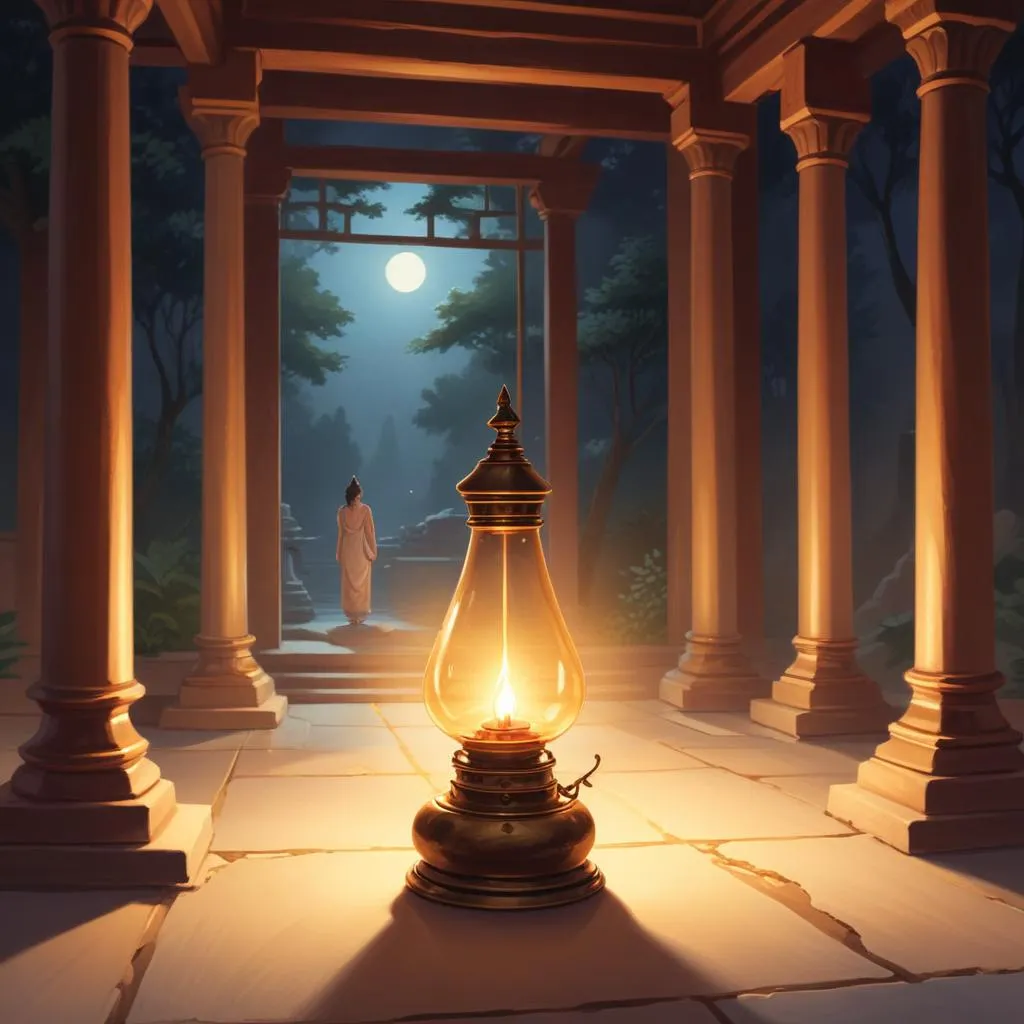
The inner light of wisdom guides the exercise of free will, as taught in the Bhagavad Gita.
Pivotal Moments of Choice
- Yudhishthira's Dice Game: He freely chooses to play, despite knowing Shakuni's deceit, driven by his karma (duty as a Kshatriya to accept a challenge) and his own weakness for gambling.
- Arjuna on the Battlefield: Paralyzed by emotional attachment, he chooses to lay down his arms. Krishna's entire discourse is an appeal to Arjuna's free will, urging him to choose the righteous path of duty (Swadharma) without attachment to results.
- Karna's Loyalty: Despite knowing the Pandavas are his brothers, Karna repeatedly chooses loyalty to Duryodhana, a decision born from gratitude and personal honor that seals his tragic fate.
The Synthesis: Karma and Free Will in Tandem
The Mahabharata's genius lies in showing how karma and free will are not enemies but partners in soul-making. Karma provides the context, free will provides the response. Our past actions create the "field" (Kshetra) of our life—our family, body, talents, and challenges. But how we act in that field is our free will. Krishna's instruction in the Gita to "perform your prescribed duty, for action is better than inaction" is a call to engage with our karmic circumstances through righteous action, thereby creating new, positive karma.
The Role of Wisdom and Detachment
The key to navigating this interplay is Buddhi (discriminative intelligence) and Nishkama Karma (action without desire for the fruit). When Arjuna acts with clarity, following his dharma without being attached to winning or losing, he exercises free will in its purest form. This kind of action burns away past karmic seeds and does not bind one to new ones, leading to liberation (Moksha).

Like a river's course, life is shaped by both its source (past karma) and the terrain it flows through (present choices).
Modern Relevance: Lessons for Contemporary Life
The Mahabharata's discourse is strikingly modern. It teaches us that we are not victims of fate. While we inherit certain situations (genetic, social, economic), we have the power to choose our attitude and response. A difficult circumstance (bad karma) can be met with courage and integrity (good use of free will), transforming it into an opportunity for growth. Conversely, a fortunate situation can be squandered through poor choices.
Ultimately, the epic encourages self-responsibility. It asks us to focus not on what life has dealt us, but on how skillfully we play the hand. By making conscious, dharmic choices, we actively shape our future destiny, proving that within the grand framework of karma, the human will remains the most potent creative force.