
The forest path represents the difficult journey of exile
The Mahabharata, one of the world's greatest epics, contains countless stories of heroism, duty, and sacrifice. Among its most compelling narratives is the thirteen-year exile of the Pandavas, a period that tested their resilience, relationships, and principles. While all five brothers faced hardship, Draupadi's suffering during this period offers a unique perspective on the intersection of gender, status, and emotional turmoil in ancient Indian society.
From Palace to Wilderness: The Shock of Displacement
Draupadi, born from fire and raised as a princess, was accustomed to the luxuries and comforts of royal life. As the queen of Indraprastha, she presided over one of the most magnificent courts in the epic. The sudden transition from silk garments to tree bark, from golden palaces to makeshift forest huts, represented more than just physical hardship—it was a complete inversion of her identity.
Unlike her husbands, who were warriors accustomed to hardship, Draupadi's entire existence had been defined by royal privilege. Her suffering in exile was therefore multidimensional:
- Physical discomfort: The lack of familiar comforts and constant struggle for basic necessities
- Social humiliation: The fall from respected queen to forest dweller
- Psychological trauma: The memory of her public humiliation in the Kaurava court
- Maternal anxiety: Separation from her children who were sent for safety
The Unhealed Wound: Draupadi's Quest for Justice
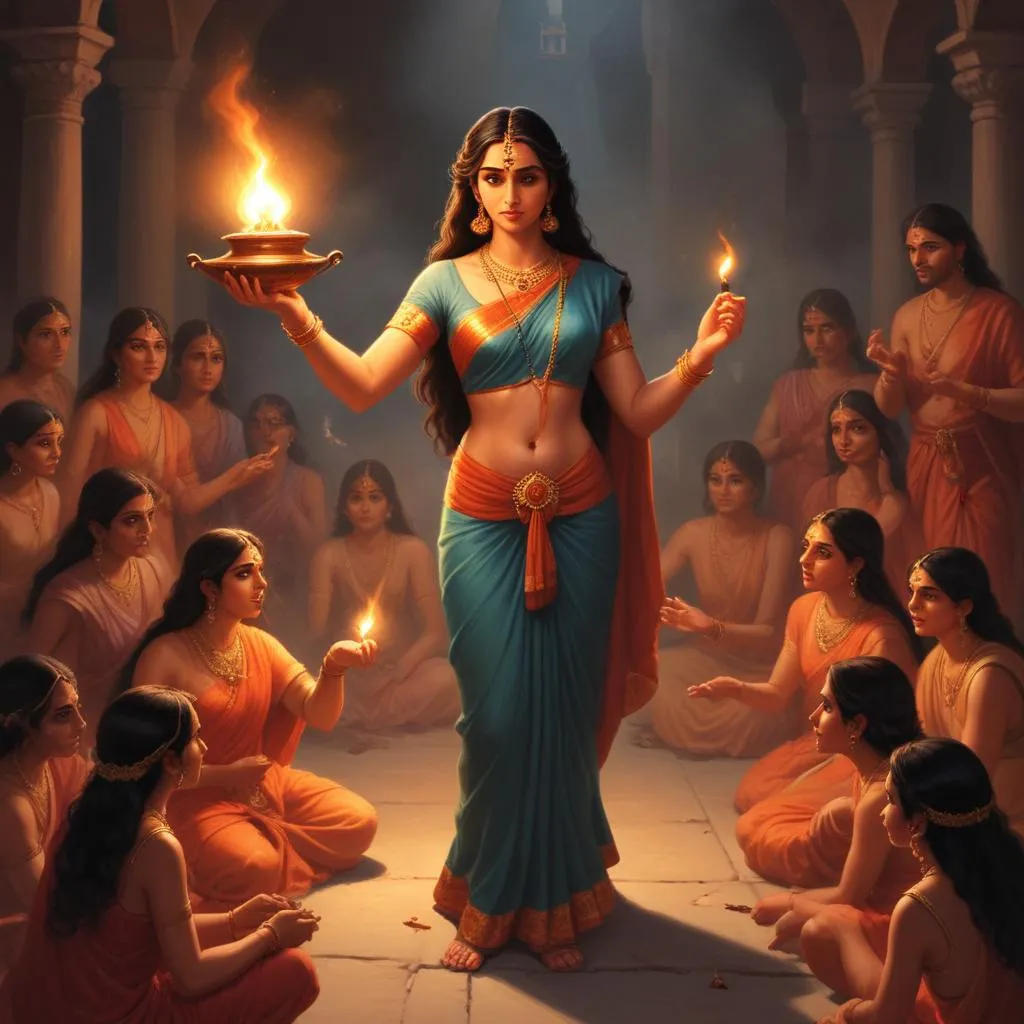
The burning lamp symbolizes Draupadi's undying quest for justice
Draupadi's time in exile was shadowed by the memory of the dice game and the subsequent attempt to disrobe her in the Kaurava court. While the Pandavas seemed to accept their fate with philosophical resignation, Draupadi nursed her anger and humiliation, transforming it into a powerful motivation for justice.
Her famous vow—to not tie her hair until she could wash it with the blood of Dushasana—was not merely an expression of revenge but a symbolic refusal to forget injustice. In a society that often expected women to quietly bear humiliation, Draupadi's persistent anger was revolutionary.
"I will tie my hair only after I have oiled it with the blood of Dushasana. This is my vow."
This unwavering commitment to justice, even in the face of societal pressure to forgive and forget, reveals Draupadi's extraordinary moral clarity and strength of character.
The Complexity of Polyandry in Exile
Draupadi's unique position as wife to five husbands created additional layers of complexity during exile. While the Pandavas shared a wife, they did not share equal emotional connections with her. Draupadi had to navigate these different relationships while dealing with her own suffering.
Her relationships with each Pandava reflected different aspects of her personality and needs:
- Yudhishthira: The philosophical but often impractical husband whose decisions led to their exile
- Bhima: The protective warrior who shared her thirst for justice
- Arjuna: The husband she loved most but who was often absent
- Nakula and Sahadeva: The younger brothers who provided support and companionship
This complex web of relationships meant that Draupadi could never fully express her suffering to any one husband, as each had different capacities for understanding her pain.
Spiritual Transformation in the Forest

The forest river symbolizes purification and spiritual renewal
Despite the hardships, Draupadi's exile period also represented a journey of spiritual growth. Away from the politics and luxuries of court life, she developed deeper aspects of her character:
Resilience Through Adversity
The forest demanded practical survival skills that Draupadi had never needed in the palace. Her adaptation to these challenges revealed a resilience that complemented her already strong character.
Deepened Spiritual Understanding
Numerous episodes in the Vanaparva show Draupadi engaging in philosophical discussions, particularly with Yudhishthira, demonstrating her intellectual and spiritual depth beyond her role as queen and wife.
Strengthened Resolve
Rather than breaking her spirit, the exile refined Draupadi's determination. Her suffering became a crucible that tempered her resolve and clarified her purpose.
Draupadi's Legacy: The Queen in Exile
Draupadi's experience of exile offers profound insights into the human capacity to endure suffering while maintaining dignity and purpose. Her story resonates across centuries because it speaks to universal themes:
- The struggle to maintain identity when external markers of status are stripped away
- The tension between forgiveness and the demand for justice
- The complex navigation of relationships during shared hardship
- The transformation of suffering into strength
Draupadi's longing during her years in the forest was not merely for restored comfort and status, but for restored honor, justice, and the vindication of her personhood. Her suffering, rather than diminishing her, ultimately became the source of her legendary strength—a queen who carried her royalty within, regardless of her external circumstances.